
Procurement teams evaluating industrial scrubber dryers often focus on technical specifications: power, tank capacity and battery autonomy. This approach assumes that higher-spec machines automatically deliver better results, which then seems to justify a higher investment compared with more affordable alternatives.
Our experience across professional facilities has shown a very different reality. €4,000 scrubber dryers can remain in service for 7 to 8 years in sites with solid protocols, while more expensive premium machines may need replacing after only 4 or 5 years when they are operated without training, supervision or systematic preventive maintenance.
Industrial scrubber dryer TCO is not determined by the machine’s specifications alone. It is shaped by the operating ecosystem: staff stability, documented protocols, technical supervision and a real commitment to preventive maintenance.
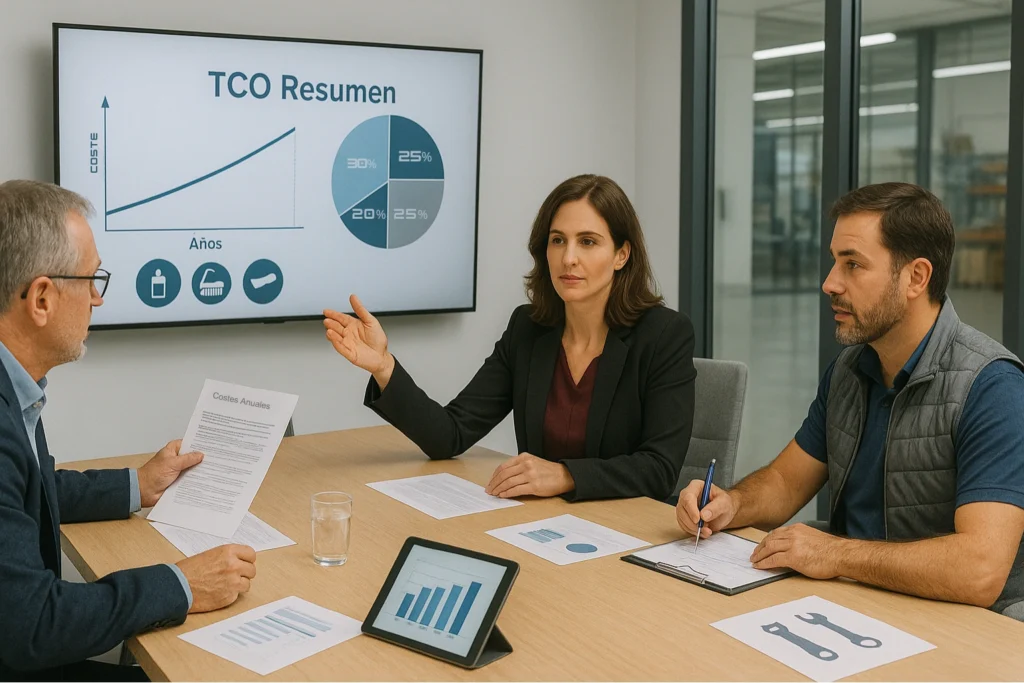
The TCO paradox: when €4,000 outperforms €8,000
A €4,000 industrial scrubber dryer with a theoretical service life of 5 years can reach a real-life service life of 7 to 8 years when operated by trained, stable staff, supported by maintenance, supervision that detects early anomalies and specific protocols for each floor type. A basic machine becomes a sound investment when supported by a robust operating ecosystem.
The opposite scenario is just as common: €8,000 premium machines with a theoretical life of 7 years failing after only a few years in sites with high staff turnover. Each new operator without specific training applies incorrect settings that accelerate wear. In the absence of written protocols, each person operates the machine according to personal judgement, using the wrong accessories, excessive speed, poor chemical dosing or inadequate cleaning and maintenance.
Contract changes make the problem worse. When the cleaning provider changes, and the machinery changes with it, the knowledge built up around the equipment is lost. Staff who were already familiar with one type of machine repeat mistakes for months with the new one, gradually consuming its service life.
The overall TCO difference between these two scenarios is significant, once initial investment, accumulated repairs and downtime are taken into account. A lower-cost machine within a strong operating ecosystem can generate a lower cost than a premium machine subjected to poor operational use.
Human factors: the real driver of TCO in professional cleaning
Staff turnover: loss of operational knowledge
The professional cleaning sector is known for high staff turnover, especially in facilities with night shifts or demanding working conditions. Every departure represents the loss of tacit operational knowledge: recognising changes in sound that indicate tired bearings, knowing which accessory to use on which surface, or spotting when squeegee blades are starting to lose sealing before they begin leaving streaks.
The replacement operator will often work mechanically for some time before developing similar instinct. During that period, small issues can go unnoticed until they become major breakdowns, while real productivity remains lower than what the experienced operator had been able to achieve.
Documented protocols
Facilities with specific written protocols achieve better longevity from their cleaning machinery. A useful protocol records:
- Optimum speed according to soil level
- Chemical dosing by application
- Warning signs that require immediate inspection
- Mandatory daily post-use maintenance
These protocols make operational knowledge transferable. A new operator can work correctly from day one. The learning curve is reduced from months to weeks, limiting the damage caused by inexperience.
After-sales costs: how poor use multiplies repairs
Accelerated wear caused by incorrect operation
Repeated incorrect use generates progressive wear. Applying excessive pressure with the wrong brush because it “cleans faster” puts strain on bearings, deforms supports and overloads the motor. This cumulative damage can reduce component life to half of what would normally be expected.
Excessive chemical dosing not only wastes product. It also creates build-up at the bottom of the tanks which, together with limescale, forms a viscous residue that blocks dosing components.
The real cost: spare parts, downtime and labour
An emergency repair creates three separate costs:
- Direct cost: motor plus 3 hours of labour
- Downtime: 48 hours without the machine forces manual cleaning, which takes 3 to 4 times longer
- Urgency cost: overpriced spare parts, express shipping and emergency technician call-outs
The real overall cost is much higher than the repair invoice alone. Facilities without preventive maintenance suffer breakdowns 2 to 3 times more often, forcing spending on repairs and spare parts to double or even triple compared with what would otherwise be expected.
Technical TCO components
Recurring consumables
Chemicals are the largest recurring cost. Automatic dosing systems remove the 30% to 40% waste that is typical of manual dosing.
Brushes and squeegee blades are another key factor. Original components can last 2 to 3 times longer than cheaper alternatives.
Batteries also play a major role. Lead-acid and gel batteries generally need replacement every 2 to 3 years. Lithium batteries such as TASKI IntelliPower can provide 4 to 6 years of service life with 2,000 to 2,500 cycles, generating up to 25% TCO savings.
Maintenance: preventive vs corrective
Scheduled preventive maintenance creates predictable costs of around 8% to 12% of annual equipment value. It includes inspections, calibrations and preventive replacement of wear components.
Corrective maintenance, driven by emergencies, can rise to 25% to 40% of annual equipment value when there is no preventive programme in place. These failures usually occur at critical moments, multiplying their operational impact.
Three pillars of the optimum operating ecosystem
1. Continuous training
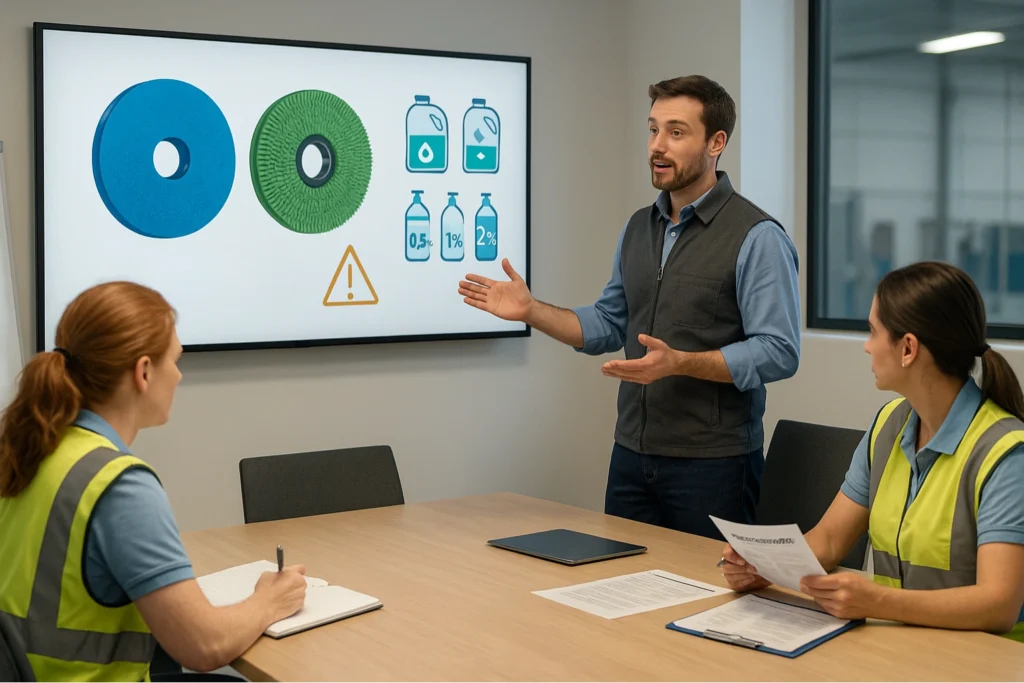
Specific training for professional cleaning machines reduces breakdowns caused by misuse and allows full efficiency from the first day. In high-turnover environments, continuous training programmes with quarterly refreshers and full induction training for new starters help minimise operational mistreatment.
2. Documented preventive maintenance
Maintenance contracts should reflect usage intensity and operating conditions. They provide inspections that detect problems before they escalate. A specialist technician can identify issues early: settings that need adjustment, components approaching end of life or incorrect configurations that would otherwise go unnoticed.
3. Competent technical supervision
Supervision by technically competent staff within the cleaning contractor greatly increases the effectiveness of the protocols in place. Their routine inspection can provide enough information to detect early problems without needing official technicians on site at all times.
HeySupply: integrated operating solutions for industrial cleaning
As authorised distributors of TASKI and Lavor, at HeySupply we understand that a machine without an operating ecosystem will fail early. Our approach includes:
- Included technical training: we train teams in operation, setting optimisation, early fault detection and preventive maintenance
- Tailored protocols: we develop site-specific protocols based on surfaces, intensity of use and operational particularities, helping preserve knowledge and reduce the impact of turnover
- Official technical support: TASKI and Lavor warranties with accurate technical diagnosis and 48 to 72-hour response times that help reduce downtime
- Original spare parts: these protect the warranty and help prevent knock-on failures
A proper TCO analysis has to reflect operational reality. Is turnover high? Are contractor changes frequent? Is technical supervision in place? Is there a maintenance culture? The answer to those questions determines which investment will generate the lowest TCO in that specific context.
The total cost of ownership of industrial scrubber dryers is not just a technical equation. It is the result of the interaction between technology and human factors. The smart decision is to identify the right balance between technical capability and operational capability.
Is your organisation still evaluating machines based only on specifications? Contact HeySupply for a broader assessment that looks at your real operating ecosystem and identifies the investment most likely to generate the lowest TCO in your specific situation.